Showing posts with label Billy McVicker. Show all posts

Monday, March 12, 2012

Gozo Cistern Exploration


Today, we took the ferry over to Gozo to explore 2 cisterns from last year and 1 new cistern all at the Citadel on the island of Gozo. In all three of the cisterns we visited today, the water was very murky causing no line of site (even with lasers); therefore, we only were only able to get sonar data and ROV sensor measurements at the bottom of the cisterns. Specifically, we were able to get really good scans of one of the cisterns revisited, nicknamed "The Keyhole". The scans last year from this site included some holes which were virtually filled. With the new data, we can estimate the accuracy of how well our hole filling algorithm is working.

After collecting data, our guide, George Azzopardi, gave us a quick tour of the Museum of Archaeology at the Citadel. The museum was really interesting with many artifacts from pottery to ancient utensils and figurines. After the tour, we stopped by a beautiful scenic site named "Azure Window" seen in the image below.

On the way back to the ferry, we stopped by the site that we will be visited on Thursday and Friday. The location was in a beautiful grassy field off of a very narrow gravel road. More will be posted about this place later this week.


Shortly after returning to the apartments, Chris Clark arrived! He kindly greeted us with groceries filled with delicious snacks :) Dinner was filled with many adventurous and personal stories about each of the members on the team. Another highlight of the day was submitting one of our papers to the IROS 2012 conference. This paper focused on the algorithm developed throughout the past year on mapping the cisterns visited last year, which will likely be used continually throughout the ongoing Malta Cistern Mapping Project.

Tuesday, March 6, 2012

Sicily Cisterns

Sunday morning we woke up quite early (~4:30am) and packed up the apartment to jump on a ferry headed for Sicily along with Keith, a friend and colleague of Timmy Gambin's, who is studying archaeology for his PhD at the University of Malta. The ferry ride was an hour and a half long and rocked us all to sleep, well at least some of us. The ferry landed in Pozzallo and then we took a 4hr bus ride to Carini (in the province of Palermo, Sicily) on the north western side of the island where we are staying at a hotel.

Upon arriving to the site, we unpacked our luggage and then attended a lecture from Keith about water management in Malta and also how it compares to Sicily. This directly ties into our work with cistern mapping and visualization. After the lecture, we got dinner and then ran through a system check to verify all the equipment was working. We ran into some problems when verifying sonar operation; however, during deployment, the sonar decided to behave and provide beautiful sonar scans.

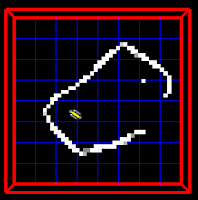
We are scheduled to visit several different cisterns here, which were setup through Timmy (our awesome Maltese contact). So far, we visited 2 cisterns. The location we visited today (Tuesday) is known as Case Cutietta and is located in Carini itself. The location was originally a basilica and is now privately owned. This site is of special interest because 5 years ago during excavation, a mosaicked floor was recovered from the original basilica. The archeologist suspect that the cistern we explored also contains a mosaicked floor as it probably was a Roman room. We deployed the robot and collected sonar scans, and video, but did not find any evidence of a mosaicked floor due to much dirt and debris. The shape of the cistern is rectangular as seen to the right.


Overall, our experience here in Sicily has been great. Besides all the great programming the team has been doing and the field work we experienced today, we still have been able to stroll along the beach and get a whiff of fresh air as well as experience a very evident Italian culture. Keith has been very gracious through providing extensive knowledge about Sicily and the different sites. We have also been relying on him for his translation abilities :)

Sunday, January 29, 2012

Cultural Update

So as mentioned last week, we all (the Cal Poly folks) are studying Malta in an Ethnic Studies class here at Cal Poly. This past week the class broke up into groups and focused on different eras of Malta and then presented our findings to the class. I'm going to attempt to highlight some of the information we talked about. (Feel free to comment on this post to add more information).

Over the years, Malta has been ruled by many different countries starting all the way back in 5200 BC where the first settlers arrived in Malta. These settlers are thought to have arrived by boat from Sicily and where hunters and farmers. The Greeks, Phoenicians, and Romans fought over Malta up until the Middle Ages. At that point it was given to the Knights of Malta around 1530 by Emperor Charles V. Some time before Britain took over in 1814, Napoleon even ruled the island. Britain had control over the island up until Malta's independence in 1964.

As far as education goes in Malta, Britain had a large impact. The university's educational system is a mixture of British and French principles as far as working hands on versus theoretical. This combination varied over time. In the 70s, the University of Malta actually shutdown to allow for growth of vocational schools. In the early years of Malta's development as a young nation, education was so highly coveted that all expenses were paid for students from kindergarten through undergraduate. Undergraduate fees have since been applied according to the needs of the economy.

Other topics discussed involved Malta's lack of water and demographics like religion, languages, and population.

SLAM Project Update

Well it has been a while since I was suppose to post this, but that just means I'll have better results. So I've been working on optimizing the SLAM code to generate better maps and also increasing the likelihood of the particles converging for a given set of sonar scans. I started by focusing on filtering the sonar data to optimize the overlap between scans.


Filtering Algorithm


By filtering the data, I can use more of the data already present in the sonar scan to help increase the likelihood of the particles converging.

My next focus will be on refining the filtering algorithm to output cleaner sonar measurements. I also need to work on the scan matching algorithm to load in the first scan at an ideal location where edges won't be cut off. This occurs when the size of the occupancy grid is small and the first scan is loaded in the middle of the map. I'm also waiting for the ROV motor to come in the mail so that I can fix the ROV and then be able to map the pool at the LAIR. This will give us truth data to calculate the error in our algorithm.

Saturday, January 7, 2012

Robotics in SLO Update

Over break, I sent the ROV we have here at Cal Poly to VideoRay for repairs. Several parts needed to be replaced due to water leaking into the robot's hull. To my knowledge it is still under repair.

As for the software side of robotics, I worked on SLAM. I was able to get the scan matching algorithm working. This algorithm attempts to use SLAM to converge every possible pair of sonar scans of a cistern in order to localize the ROV for each scan's position.

Before we added the "Auto-converge" localization technique, we were manually mosaicking the sonar scans together and then measuring the displacement values between a reference scan and all the other scans. The displacement values for each scan were inputted into the code and used as the initial locations of the ROV when trying to add scans to a map. The code we have now does this mosaicking automatically.

The next step is to figure out how to prevent the particles from converging in the wrong location. I'm writing a paper on the Malta work from last year up till now, which is consuming most of my time.

Here are before and after images of merging two scans. Here I'm just using SLAM to add the second scan.


Using Scan Matching Algorithm w/ just 2 Scans


Saturday, December 31, 2011

Cultural & Technical Goals

Having been to Malta once already, my learning goals are probably slightly different than the rest of the team's. Culturally, I am aiming to get a deeper understanding of how Malta developed as a country in order to better understand the cultural background of the country. I'm hoping this will giving me a better insight on the Maltese traditions and cultural norms. Most of the research will occur before arriving in Malta which should allow for some interesting social interactions.

As for the technical goals, I am aiming to enhance our scan matching algorithm to handle 3D sonar scans. This will help us generate a more accurate representation of the cisterns as well as help the visualization team generate more realistic models.

Friday, November 11, 2011

Another Great Adventure!


Hi Everyone,

My name is Billy McVicker. I'm a Computer Engineer in the Computer Science 4+1 program. I'm from Grass Valley, CA and when I'm not studying/facebooking (which is rare) I like to swing dance and hangout with friends. I really enjoy solving puzzles, fixing things, and taking things apart. I was a member of the ICEX team last year and was invited back this year to help out with the robotics side of things. I had an amazing time last year, learned a whole lot, and know that this year will be just as great. (The picture attached is a good representation of how much fun we have in Malta).